

Install it
Two commands. The first goes in a terminal, before you open your coding agent:reticle_* tools are there the next time you open one. Then, in your project, npx @reticlehq/server init wires the app. The quickstart walks both.
Or hand the whole thing to your agent
Copy the block below into Claude Code, Cursor, Copilot, Codex, Windsurf, OpenCode, or any MCP agent. It ends with the only definition of “installed” that counts: one real flow driven, one real verdict returned.What that command actually changes
The four files it writes, the marks it prints, and how to read its report.
Quickstart
Install, connect your agent, and get a real verdict. Five minutes.
Why Reticle
The false-green problem, and the evidence that this fixes it.
Desktop apps
Electron and Tauri, including the IPC boundary nothing else can see.
Install
Let your agent do it, or wire it by hand.
Tools
Every tool, with a real request and a real response.
Run it in CI
Turn a session into a suite that blocks a bad merge.
What it looks like
Your agent names the expected consequence before it acts. That ordering is the whole trick. It is the difference between a check and a rationalisation.unknown is not a pass; it means Reticle drove the app and could not tell. It says so rather than guessing, which is a rarer quality in software than it should be.
What makes it different
No screenshots
No vision model, no pixel guessing. Reticle reads program truth, so the answer is deterministic
and the same every run.
Points at the source
On React, a DOM node maps back to
src/App.tsx:104. Finding the bug is half the job; knowing
which file to open is the half that makes an agent useful.Cheap to ask
Narrow questions instead of dumping the whole accessibility tree into the context window every
single step.
Yours, locally
Dev-only, localhost-only, offline. Your app’s data never leaves the machine.
The evidence
We publish the losses too. Reticle is not the right tool for driving a site you don’t own, and it does not see pixels.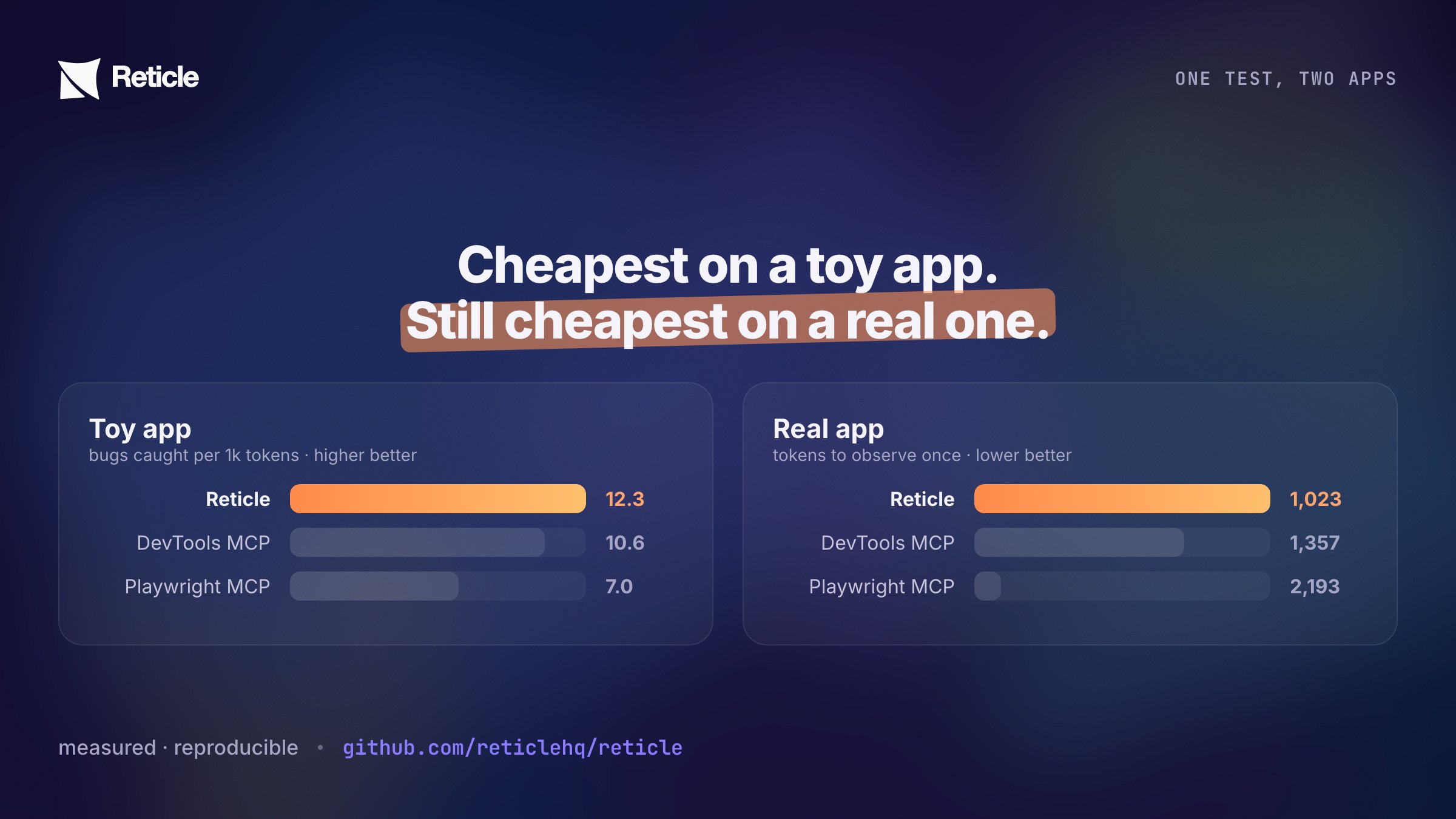
Read the full benchmark
How every number was measured, what it means, and where Reticle comes second.
Built for agents, readable by humans
Reticle is used by a coding agent far more often than by a person, so these docs are built to be fetched by one. Every page has a plain-Markdown twin, and the whole site collapses into a single file when an agent wants the lot.Docs for agents
Markdown endpoints,
llms.txt, and which page answers which question.Build with us
Reticle is early, and the sharp edges get filed down fastest when someone tells us where they are.Join the Discord
Ask questions, show us what you are verifying, and tell us what broke. The roadmap moves on what
people actually hit.
Star the repo
It is the cheapest way to help, and it is genuinely how other people find this.
reticle_feedback sends it in one call, from wherever you are. If Reticle could not tell you what happened, that is our defect and we want to know.